Julian Chehirian is a historian of science and artist working on the history of the mind sciences.
The Neighbours
The Neighbours is a temporary memorial, a fractious museum, and a transitory archive of the Bulgarian gulag. Through multimedia installation and social practice, the project unsilences a history of political violence left unacknowledged by the Bulgarian state after 1989 — sustaining attention to what has been systematically erased from archives, public memory, and official narrative.
The collective — Julian Chehirian, Lilia Topouzova, and Krasimira Butseva — represented the National Pavilion of Bulgaria at the 60th Venice Biennale.
About the work
The Neighbours is a multimedia installation about how we remember, carry, and forget trauma. The exhibition excavates the silenced memories of survivors of state violence from Bulgaria's socialist era (1945–1989) and explores its troubling legacy in the present.
During this period, countless individuals were sent to forced labour camps without trial, faced imprisonment, systematic persecution, forced resettlement and ethnic assimilation — political dissidents, peasants who refused to give up their land, artists, queer people, Muslim minorities, and everyday people who defied the regime's ideology.
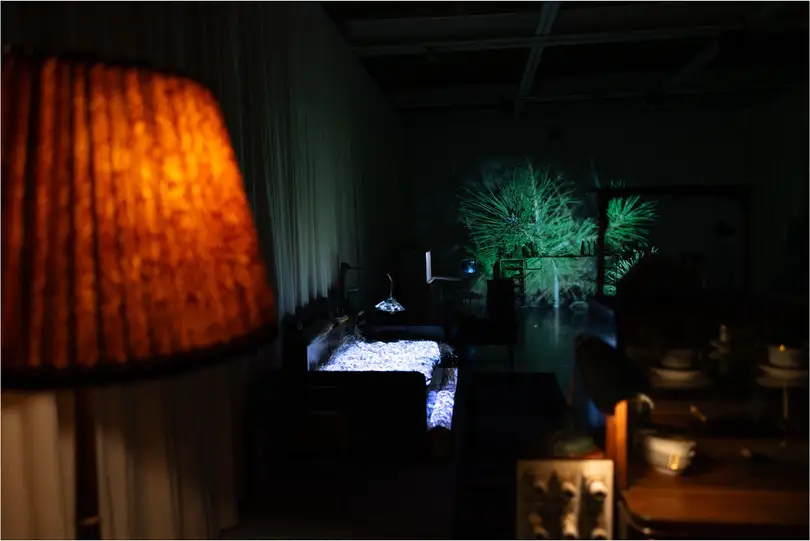
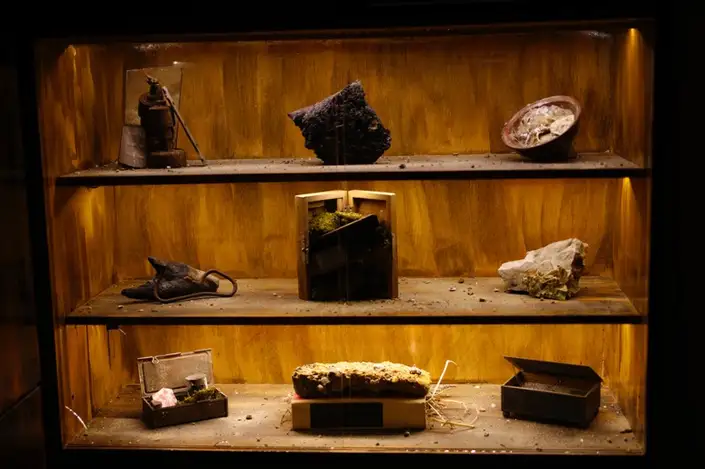
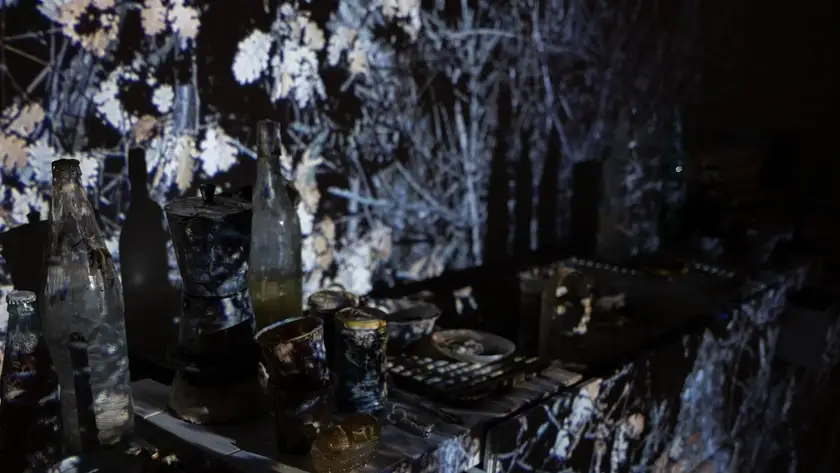
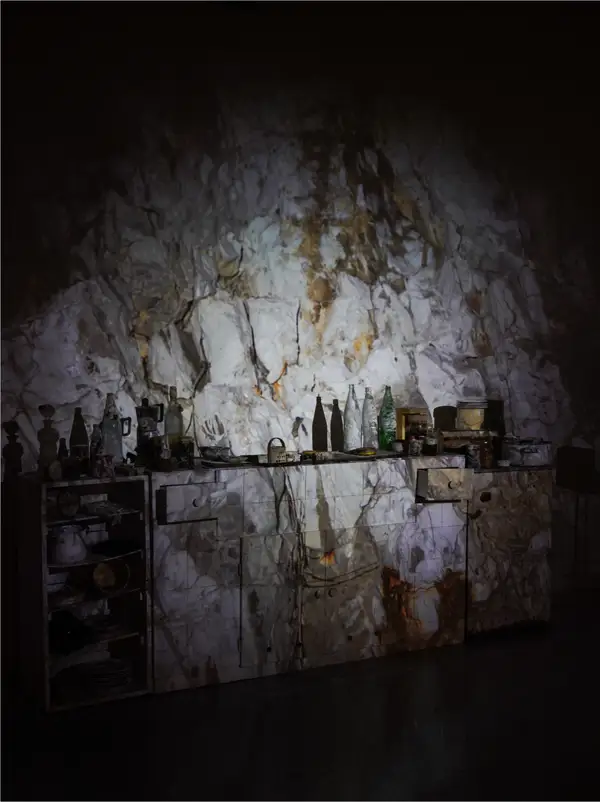
Drawing from extensive scholarly research, more than 40 interviews were conducted by the project's creators. This multidisciplinary study reimagines the survivors' domestic environments — the very spaces where these interviews took place. Through the interplay of video projections, ambient sounds, and artefacts recovered from the former sites of violence, the installation visually juxtaposes the camps' material world with the space of the home, evoking how traumatic memories permeate daily life while inviting the audience to bear witness.
Created by a team of artist-researchers working between the archive, the ethnographic encounter, and the studio, The Neighbours unsettles the distinction between scholars and artists. It portrays the role of art in tying together knowledge production with the ability to capture affect — something that often cannot be directly documented or made present.
Origins
The Neighbours was born in 2022 as a temporary museum arranged across two sites — the Sofia City Gallery and a soon-to-be-demolished printing house on Benkovski St №40. The project is the outcome of 20 years of scholarly research and 9 years of artistic collaboration, built upon 40 interviews conducted by the authors (2002–2022) with survivors of political repression and forced labour. Across the marbled floors of a state art institution and the tightly laid parquet of a decommissioned socialist-era printing house, survivors and ethnographers in conversation surfaced repressed memories of the Bulgarian gulag.
Three rooms
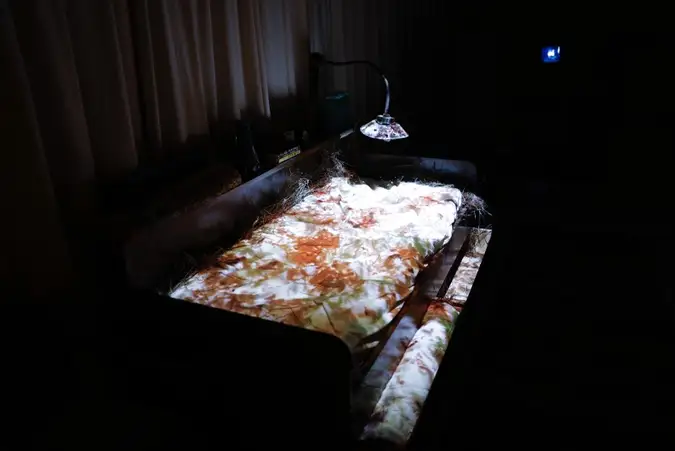
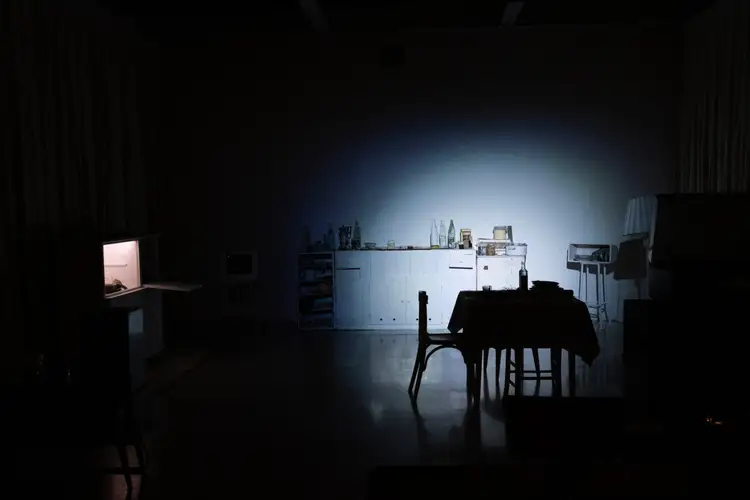
The installation spans three rooms, reflecting three ways of remembering the lived experience of state violence.
In the living room are the voices of those who remember and have been vocal about their experiences, in both the public and private spheres.
The bedroom holds the words of survivors who speak for the first time about their experiences — those who had previously been reluctant to speak out of fear, or simply because they had never been asked.
The kitchen embodies the wordless laments of people who could not speak — those who perished, those whose memories were lost, and the details of their experiences permanently silenced.
Exhibition history
- 2024 — Bulgarian Pavilion, 60th Venice Biennale. Curated by Vasil Vladimirov.
- 2023 — Princeton University, Interdisciplinary Humanities Doctoral Program.
- 2023 — University of Toronto. Curated by Vasil Vladimirov.
- 2023 — Structura Gallery, Sofia. Curated by Gregor Jansen (Kunsthalle Düsseldorf).
- 2022 — Studio The Neighbours / Sofia City Gallery. Curated by Vessela Nozharova and Krasimir Iliev.
Selected press
- The Guardian / The Observer — "Venice Biennale 2024," review by Laura Cumming
- The Guardian — "DIY spaces of remembrance," by Kate Connolly
- Artforum — "Venice Diaries: Friends and Enemies," by Pablo Larios
- Financial Times — "Beyond the Giardini and the Arsenale," by Jo-Ann Titmarsh
- Galerie — "Six Standout Pavilions from the 2024 Venice Biennale," by Caroline Roux
- ArtReview — "A Guide to the Giardini," by Oliver Basciano
- Apollo Magazine — "Must-See Pavilions," by Edward Behrens
- The Art Newspaper — "Must-See Pavilions Around Town"
- Stirworld — "STIRring 'Everywhere' in Venice," by Aimee Dawson
- Princeton University — "Princeton grad student Julian Chehirian will exhibit at the Venice Biennale"
- e-flux — "Bulgarian Pavilion at the Venice Biennale"
Project team
Julian Chehirian is a historian of science and artist. In his practice-based research he develops installations in dialogue with archival and ethnographic research, staging entangled relationships between history, psychology, and material culture. Previously a Fulbright researcher in Bulgaria, his exhibition Excavating the Psyche (Red House, Sofia, 2015) offered a survey of the history of psychotherapy during socialism. His scholarly writing appears in Culture, Medicine and Psychiatry and in edited collections for Yale University Press, Columbia University Press, Oxford University Press, and Bloomsbury.
Lilia Topouzova is an Assistant Professor of History and Creative Nonfiction at the University of Toronto, where she directs the Professional Writing and Communication Program. A scholar and documentary filmmaker, her interdisciplinary work explores the relationship between remembering and forgetting. Her research on the silenced trauma of the Bulgarian gulag appears in the American Historical Review, Gender & History, The Routledge Handbook of Memory and Place, and the Encyclopedia of Transitional Justice. She is the scriptwriter of the documentary films The Mosquito Problem & Other Stories (2007) and Saturnia (2012), which she also directed.
Krasimira Butseva is a visual artist, researcher, and educator whose work investigates human rights violations, political violence, traumatic memory, and official and unofficial histories in Eastern Europe. She is a lecturer at the London College of Communication, University of the Arts London, an awardee of BAZA (2022), and a former artist fellow at Akademie Schloss Solitude (2021). Her work has been exhibited internationally, including at Sofia History Museum, Seen Fifteen Gallery (London), District Six Museum (Cape Town), and Pingyao International Photography Festival.
Jorge Rubiera is a Cuban-American filmmaker. Over the past two decades he has written and directed over a dozen narrative and documentary shorts, and as cinematographer and editor made many more, including the Emmy-winning Hecho a Mano and the Telly-winning All-American Cuban Comet for ESPN. A longstanding collaborator on The Neighbours, he is making a documentary that follows its creation.
Martin Atanasov is a visual artist working in Sofia who studied photography at the Film Academy in Prague (FAMU). He orients his practice around the design and creation of photographic books. Martin developed the visual identity of The Neighbours, designing the exhibition book, facade billboards, posters, and printed materials.